Discovery of India by Jawaharlal Nehru
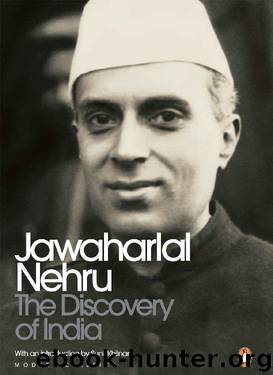
Author:Jawaharlal Nehru
Language: eng
Format: epub, mobi, azw3
ISBN: 9789385990052
Publisher: Penguin Books Ltd
Published: 2008-01-31T18:30:00+00:00
The Destruction of India’s Industry and the Decay of Her Agriculture
The chief business of the East India Company in its early period, the very object for which it was started, was to carry Indian manufactured goods, textiles, etc., as well as spices and the like from the East to Europe, where there was a great demand for these articles. With the developments in industrial techniques in England a new class of industrial capitalists rose there, demanding a change in this policy. The British market was to be closed to Indian products and the Indian market opened to British manufactures. The British Parliament, influenced by this new class, began to take a greater interest in India and the working of the East India Company. To begin with, Indian goods were excluded from Britain by legislation, and as the East India Company held a monopoly in the Indian export business, this exclusion influenced other foreign markets also. This was followed by vigorous attempts to restrict and crush Indian manufacturers by various measures and internal duties which prevented the flow of Indian goods within the country itself. British goods meanwhile had free entry. The Indian textile industry collapsed, affecting vast numbers of weavers and artisans. The process was rapid in Bengal and Bihar, elsewhere it spread gradually with the expansion of British rule and the building of railways. It continued throughout the nineteenth century, breaking up other old industries also, ship-building, metal working, glass, paper, and many crafts.
To some extent this was inevitable as the old manufacturing came into conflict with the new industrial technique. But it was hastened by political and economic pressure and no attempt was made to apply the new techniques to India. Indeed every attempt was made to prevent this happening, and thus the economic development of India was arrested and the growth of the new industry prevented. Machinery could not be imported into India. A vacuum was created which could only be filled by British goods, and which led to rapidly increasing unemployment and poverty. The classic type of modern colonial economy was built up, India becoming an agricultural colony of industrial England, supplying raw materials and providing markets for England’s industrial goods.
The liquidation of the artisan class led to unemployment on a prodigious scale. What were all these scores of millions, who had so far been engaged in industry and manufacture, to do now? Where were they to go? Their old profession was no longer open to them, the way to a new one was barred. They could die of course; that way of escape from an intolerable situation is always open. They did die in tens of millions. The English Governor-General of India, Lord Bentinck, reported in 1834 that ‘the misery hardly finds a parallel in the history of commerce. The bones of the cotton weavers are bleaching the plains of India.’
But still vast numbers of them remained, and these increased from year to year as British policy affected remoter areas of the country and created more unemployment.
Download
Discovery of India by Jawaharlal Nehru.mobi
Discovery of India by Jawaharlal Nehru.azw3
This site does not store any files on its server. We only index and link to content provided by other sites. Please contact the content providers to delete copyright contents if any and email us, we'll remove relevant links or contents immediately.
| Africa | Americas |
| Arctic & Antarctica | Asia |
| Australia & Oceania | Europe |
| Middle East | Russia |
| United States | World |
| Ancient Civilizations | Military |
| Historical Study & Educational Resources |
The Sympathizer by Viet Thanh Nguyen(4398)
The Rape of Nanking by Iris Chang(4224)
World without end by Ken Follett(3481)
Ants Among Elephants by Sujatha Gidla(3470)
Blood and Sand by Alex Von Tunzelmann(3207)
Japanese Design by Patricia J. Graham(3183)
The Queen of Nothing by Holly Black(2606)
City of Djinns: a year in Delhi by William Dalrymple(2560)
Foreign Devils on the Silk Road: The Search for the Lost Treasures of Central Asia by Peter Hopkirk(2469)
India's Ancient Past by R.S. Sharma(2461)
Inglorious Empire by Shashi Tharoor(2445)
Tokyo by Rob Goss(2435)
In Order to Live: A North Korean Girl's Journey to Freedom by Yeonmi Park(2394)
Tokyo Geek's Guide: Manga, Anime, Gaming, Cosplay, Toys, Idols & More - The Ultimate Guide to Japan's Otaku Culture by Simone Gianni(2377)
India's biggest cover-up by Dhar Anuj(2359)
The Great Game: On Secret Service in High Asia by Peter Hopkirk(2354)
Goodbye Madame Butterfly(2257)
Batik by Rudolf Smend(2190)
Living Silence in Burma by Christina Fink(2074)
